|
Parents enjoy spending time with their kids and often look for creative and quality activities to do with them. Kicking a soccer ball in the back yard, going to the local park to play catch, listening to music, or dancing together in the living room are all great activities to engage in with your child. However, consider for a moment adding a Karate class to that list of activities. The Martial Arts, Karate specifically, offers a tremendous opportunity for families to participate together in the same class while doing something that is beneficial to everyone involved. The phrase "A family that kicks together, sticks together" couldn't be any more truthful. More and more families are discovering that practicing Karate together actually encourages interaction between parents and their children, promotes sharing a common interest, and offers a number of healthy and fun benefits. So, you ask, how does practicing Karate provide these benefits? Regardless of age and skill level, Karate is a challenging activity. It offers a great exercise routine, teaches practical self-defense skills, and provides a structured environment that caters to each individual's ability. The mental, spiritual, and philosophical side of Karate can also build higher self-esteem, confidence, respect for others, positive motivation, and goal-setting skills.  The benefits of practicing Karate are many. Here are just a few that may pique your interest: FITNESS: Practicing Karate is an excellent workout that challenges the entire body and all of its muscle groups. Practicing Martial Arts burns more calories than most other activities other than swimming or running a 7-minute mile! Needless to say, it's a very good activity to maintain or improve your fitness levels and cardiovascular strength. SELF DEFENSE: Defending yourself is an important part of any practitioner's study of the Martial Arts. It is becoming more important and critical to possess a fundamental understanding and skill level of self-defense, regardless of age. Learning anti-bullying techniques and personal protection skills is just one aspect of the training. CONTINUOUS LEARNING: Karate is structured in a very systematic and progressive fashion that promotes constant refinement. Each Karate student is encouraged to practice individually and to seek knowledge for self-improvement and constant personal development. This type of teaching leads to interpersonal discipline and a solid work ethic. In a good Martial Arts school, you'll find there is always something new to learn and always something different to practice. This progressive content is introduced systematically so as not to overwhelm beginning students, while still providing a continuous challenge for intermediate and advanced students. SPIRITUALITY AND PHILOSOPHY: The philosophies contained in the Martial Arts are both valuable and beneficial to children as well as adults. The opportunity to study and practice these philosophies as a family can lead to very open and positive dialogue between parents and their children. Each of these different aspects of Karate and the Martial Arts has relevance to individuals of all ages, and consequently, parents and children are finding this to be a very enjoyable and challenging family activity for all who participate. There is nothing more fun than having a training partner — Mom, Dad, Brother, or Sister — to encourage you along the way. While training together, each individual brings their own view of the same activity to the overall experience, which leads to better communication and understanding between all family members. This improved communication will help put the "quality" in "quality time."  As you can see, enrolling in a Karate class is probably one of the best things you can do for your family. Start today and begin a journey that is well worth taking — one that will bring you and your family improved health, fitness, and fun.
If you're interested in starting your journey in Karate as a family and would like some useful information about the Martial Arts, we'd love to have you train with us at Claycomb Karate & Kickboxing in Fontana, CA. Give us a call at 909-600-6090 or visit us online at fontanakarate.com. Just remember: a family that KICKS together, STICKS together! Come train with us. 3 classes for $30. → fontanakarate.com/start
0 Comments
Every school that's serious about your money-back guarantee, your child's discipline, and your time will charge you something for a trial. Here's why "free" is the red flag, not the reward. What a free trial is actually built to do A free trial isn't generosity. It's a funnel. Someone spent money to get you in the door, and now they need to recoup it — fast. The "free" week isn't training you're being invited into. It's a sales pipeline you're being fed through, and the training is whatever's left over after the pitch. The instructor's attention is on the close, not the craft. When a trial costs the school nothing to give away, the person running it is often not the head instructor — it's whoever's job is to get you signed before the week ends. You're being sold to, not taught. It attracts the wrong room. Free draws volume. Volume dilutes a class. A dojo that fills its mat with anyone who saw an ad isn't building the same environment as one where every student, kid or adult, showed up because they chose to invest something. The real cost shows up after, in the contract. Free trials are almost always the front door to a long-term membership agreement, priced to make up for the week they gave away. The pressure to sign gets heavier precisely because you didn't pay anything going in. You get zero signal about commitment — yours or theirs. Nothing was risked, so nothing is proven. A free trial tells you what a school looks like when it's performing for a stranger. It tells you nothing about what training actually feels like six months in.  Students training Shotokan Karate at Claycomb Academy in Fontana, CA  Two trials, two very different weeks The free trial — built to convert:
Why we charge $30 for three days Thirty dollars isn't a paywall. It's a filter — for the school as much as for you. It means we're not chasing a quota of free sign-ups, and it means the people on our mats during your trial actually want to be there too. Real Shotokan karate, taught by real black belts, with a lineage you can trace back generation by generation. Not a script, not a hard close, not a contract shoved at you on day three. If three days of honest instruction don't make the case for themselves, no discount ever will. That's the whole philosophy: family-operated, real lineage, no pressure, no gimmicks. Why we don't do walk-ins You won't find an open house at Claycomb. No walking in off the street to sit on a bench and watch a class. No drop-in, no "come whenever." Every visit is by appointment — and that's not an accident, it's a policy. Here's why. A school that lets anyone wander in whenever they want isn't protecting anything — not the class in progress, not the kids training, not your first impression of the dojo. It's optimizing for foot traffic, not for the room. Every other gym in this area runs an open-door policy. We don't, because an open door is a school that's built for volume, not for serious training. An appointment means when you show up, we're ready for you. Someone is expecting you, your visit gets full attention, and the class you're watching wasn't disrupted by a stranger walking in mid-kata. It also means you took a small, deliberate step to be there — which is exactly the kind of follow-through we're trying to build in every student who trains here. If a school will let anyone in the door at any time, ask yourself what that says about who else is going to be training next to your kid. A note from me personally I'm Shihan Joseph Claycomb, and I want to be straight about who I'm building this school for. I'm not trying to grow Claycomb Karate by stacking up as many sign-ups as I can get. I'm trying to grow it with serious families — people who show up because they want to learn the art itself, and who want their kids to actually gain what training gives them: discipline, focus, respect, real confidence that gets earned on the mat, not handed out. I'm passionate about teaching, and I'm passionate about my students' success. That's not a tagline — it's the reason I still get on the mat myself. What I teach is real Shotokan karate, no gimmicks, no watered-down curriculum dressed up to keep people entertained. If you train here, you're learning the actual art, the way it was passed down to me. This isn't babysitting. I'm not interested in being a place where a kid gets dropped off so a parent can get an hour back. I'm looking for parents who see training as something they're doing alongside their kid, not a service they're outsourcing a problem to. If you want your son or daughter to grow through consistent effort over time, we're the right room. If you're hoping one class a week quietly solves something at home, we're not. What I'm looking for are families who are going to stick. People who are in it because they actually want this for their kid, or for themselves — not people who disappear the second their school schedule shifts or their budget gets a little tight. I'd rather have a room of twenty families who train with us for years than two hundred who quit in a month. That's what the $30 trial is really screening for. Not your wallet. Your follow-through. — Shihan Joseph Claycomb, Claycomb Karate & Kickboxing Come see for yourself Three days on the mat. Thirty dollars. No contract pitch. Train with a real Shotokan lineage under Shihan Joseph Claycomb — kids and adults, Fontana, CA. What Is Shotokan Karate? The Most Powerful Traditional Style Explained — Claycomb Academy Fontana CA6/8/2026 Most people have heard the word "karate". Very few actually know what it means. Shotokan Karate is not a sport. It is not a fitness class with kicks. It is a complete martial art developed in Japan with a direct lineage tracing back to the father of modern karate, Master Gichin Funakoshi. Every technique, every stance, every kata has a purpose — and that purpose is to develop a human being who is capable, disciplined, and dangerous when they need to be. At Claycomb Academy in Fontana, CA, we teach authentic Shotokan Karate. Not a watered-down version. Not a McDojo belt factory. The real thing — with a lineage that runs directly from Master Masatoshi Nakayama through the late Kancho Toshiatsu Sasaki (8th Dan, founder of JKMO) to Shihan Joseph Claycomb, 7th Dan.  Shihan Joseph Claycomb with the late Kancho Toshiatsu Sasaki, 8th Dan, founder of JKMO (Japan Karate-do Maruyoshikai Organization What Makes Shotokan Different? Shotokan is known for three things that set it apart from other styles: 1. Powerful, Linear Techniques Shotokan emphasizes deep stances, explosive hip rotation, and devastating linear strikes. The goal is maximum power through perfect mechanics — not flashy movements, but techniques that work under pressure. 2. Kata — The Living Encyclopedia Kata are pre-arranged sequences of movement that encode centuries of combat wisdom. Each kata is a complete fighting system. At Claycomb Academy, we don't just perform kata — we study what they mean and how to apply every technique in real situations. 3. Kumite — Controlled Combat Sparring in Shotokan is not brawling. It is the laboratory where your techniques are tested. You learn timing, distance, composure under pressure, and the ability to commit fully — skills that transfer far beyond the dojo. Who Trains Shotokan? Serious people. People who want more than a certificate. Athletes who want to become complete martial artists. Adults who want to develop real capability, real discipline, and real confidence. Parents who want their children trained by instructors who actually care about their development — not just their enrollment. Shotokan has been the foundation of champions, military combatants, and lifelong practitioners across the world. Lyoto Machida — one of the most successful UFC fighters in history — built his game on Shotokan. That is not a coincidence.  Xena, Michael Claycomb receiving his 3rd Dan certificate, Shihan Joseph Claycomb, and brother Mohammad at Claycomb Academy This Is Not For Everyone
Claycomb Academy is Fontana's only authentic Shotokan school. We are a family-run dojo where instruction is personal, standards are real, and every student is treated like they matter. We do not rush belt promotions. We do not sell rank. We teach Karate the way it was meant to be taught. If you are looking for a quick fix or a casual hobby, this is not the place. If you are serious — this is exactly where you belong. Come train with us. 3 classes for $30. → fontanakarate.com/start In today’s world, many schools use the word Karate loosely to describe almost any form of striking or kick-based martial art. This has led to confusion and, unfortunately, the spread of programs that have little or no connection to the true heritage of Karate. Karate is NOT a "catch-all" term for martial arts. It is not Taekwondo, Kajukenbo, American Kenpo, or any other modern hybrid style that cannot trace its direct lineage to Japan or Okinawa. Systems such as Taekwondo, Moo Duk Kwan, and Soo Bahk Do are Korean arts — each with their own history and philosophy — but they are not Karate. Similarly, any Americanized “Karate” program that emphasizes entertainment over discipline, authenticity, and tradition should not be mistaken for genuine Karate training. Authentic Karate is Japanese and Okinawan in origin. The modern systems recognized as legitimate forms of Karate include:
 The Origin of the Word “Karate”The term “Karate” (空手) means “empty hand.”
Originally, the characters used for Karate (唐手) meant “China hand,” reflecting the early Chinese influence on Okinawan martial culture. In the 1930s, Gichin Funakoshi, the founder of Shotokan Karate, changed the meaning to “empty hand,” emphasizing the spiritual and philosophical aspect of training — the idea that the practitioner’s body and spirit, rather than weapons, are the tools of defense. Gichin Funakoshi and the Spread of Karate in Japan. Gichin Funakoshi (1868–1957) is widely regarded as the father of modern Karate. He introduced Okinawan Karate to mainland Japan in the early 1920s, demonstrating it at Tokyo University and inspiring students and martial artists nationwide. His dedication to discipline, humility, and character development shaped Karate into both a martial art and a way of life. In 1949, his students founded the Japan Karate Association (JKA) to preserve, promote, and standardize authentic Shotokan Karate worldwide. Under the JKA’s leadership, Karate spread across the globe — maintaining its roots in Japanese culture, philosophy, and technique. The Importance of Authentic LineageTo be called Karate, a system must be able to trace its lineage directly back to the Okinawan and Japanese masters who codified the art. If a school cannot establish this connection, it is not Karate — regardless of what name they use on their sign. At Claycomb Academy of Martial Arts, we uphold the true traditions of Japanese Karate — rooted in discipline, respect, and the authentic legacy passed down from Okinawa and Japan to the modern world. Come train with us. 3 classes for $30. → fontanakarate.com/start Q; What is Mokuso? A: The practice of clearing the mind before and after training while sitting in Seiza. Or in layman's terms "meditation" With all that goes on in our lives and all the rush, distractions, videos games, television, Internet, advertisements, traffic, bills, stress, anxiety and stimulation overload that comes with living in the era of the 2000's, we have to wonder, why do so many of us often get distracted or find it difficult to mentally focus and releive stress and in some instances we cant even find the time to just relax. Mokuso (meditation) is a simple exercise that can help with many of these challenges. The real importance of mokso is not just doing it once in a while, rather it's the benefits of practicing it sincerely when you do actually perform it. Just like a computer, sometimes we need to push the reset button. Mokuso can help the student clear their mind and DE-STIMULATE. It can help a person relax and slow down after a hard long day or after an intense training session at the dojo. After a full day of school, work or life in general, the mind has experienced so many things at such a fast pace that it is a wonder why we often feel we're in the fast lane lifestyle and never seem to have time for anything or cant seem to slow down until the day is over. Mokuso allows us to clear our mind both before an activity we wish to excel at as well as relax and RESET afterwards. Karate practice benefit the mind, body and spirit. Typically the mind and body follow each other almost in unison while the spirit or the inner-self of a person tags along and feels the effect that the other two are engaged in. Example, when we do acts of kindness or positive actions, our spirit or inner-self tends to feel the positive effects of the actions we are doing. This goes for NEGATIVE actions as well. This can apply to clearing the mind too. If we practice Mokuso often and sincerely eventually our inner-self will feel the effects of it as well. We can start to feel relaxed and calm, yet even more alert and energized than before. Personally I feel it is a very important part of training and it should be practiced often on your own time, not just in the dojo. Children, with the help of their parents can learn to re-focus themselves while doing homework to re-energize their efforts and minds enabling them to complete their studies with less effort simply by doing a couple minutes of mokuso. 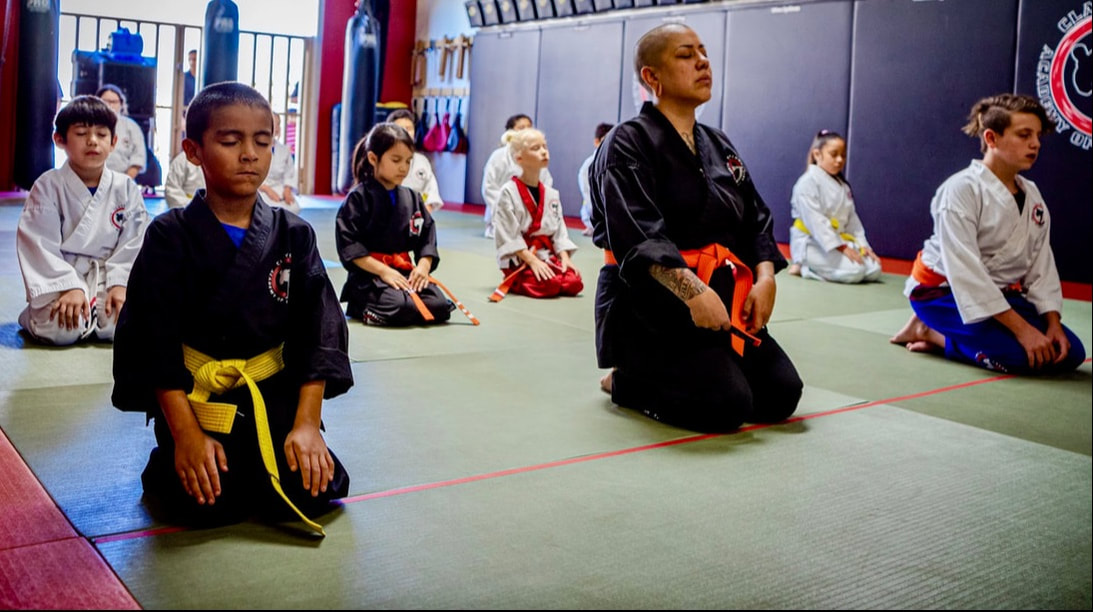 Good Mokuso practice habits:
- Sit upright in Seiza (kneeling) or Anza (cross legged) - Keep eyes closed entire time. - Breath deeply and completely at a steady and natural pace. - Ignore sounds or distractions. - Remain completely still - Focus on OR think about techniques you just practiced during your training. Performing a KATA in your mind is also a great exercise. (this helps information burn in to your memory) - Ignore any Itches, aches, numbness in your legs while sitting or even sweat dripping down your face. - Visualize what you are thinking about with mental images. - Do not rush, perform Mokuso between 30 - 60 complete breath cycles, (should take about 3 - 5 minutes.) There are many other helpful tips but these are just some of the important ones. Parents and children alike can practice this at home together, I encourage it. Try it out and see the effects of clearing your mind during Mokso and let me know if you have seen a difference in yourself. Ready to experience Mokuso and real Shotokan training? Try 3 classes for $30 → fontanakarate.com/start Oss, Good Training. 1) Sho-shin – Beginner’s Mind This refers to the type of mentality you probably had when you first started martial arts. everything was new and exciting. You were eager to learn. You had an open minded eagerness, and you had no preconceptions of how to do your techniques. you had nothing to compare it to or relate to any previous experience. You just wanted to learn. This is the mentality that you need to have even at at advances level or experience in you martial arts training. Don’t fall into the trap of thinking that you know everything that you need to know. ALWAYS Maintain a beginner’s mind. Remain Humble. The person who thinks he or she already knows everything, is not open to learning anything. Maintain Sho-shin when you are training with others and continue to learn from everyone you meet. 2) Zan-shin – Lingering Mind “Awareness” Zan-shin is a state of mind where you are totally in the present moment. It is a state where you are completely aware of your environment and your surroundings. You are relaxed, but completely aware and alert of everything around you and even a sense of the time that has passed or events that are about to come. It is a state of being totally aware of your environment – front, back, up, down, and both sides. It is total awareness, a state of where your mind is always alert and prepared for action. Zan-Shin can only be achieved by serious practice and training, not playing around. 3) Mu-shin – No Mind Mu-shin literally means mind-no-mind or “empty mind”. It is a state where you are acting but not having to think about your actions. Achieving the state of Mu-shin is at the core of Japanese martial arts and can only be achieved by years of practice. The moon’s reflection in a lake is only clear when the water is perfectly still. If there are waves or ripples, the moon’s reflection is distorted. You could think of Mu-shin as being a state of mind where there is no distortion or thoughts, yet you are still acting. The Japanese say that Mu-shin cannot be understood with the intellect, but rather, it must be experienced. And that is true. When you go into Mu-shin, your mind is quiet, but your body is acting. To achieve this state, your mind must be free from any conscious thought, including anger, hesitation, doubt, fear, or thinking about how to do what you are doing. You simply act. You allow your spirit to guide your body.  4) Fudo-shin – Immovable Mind
Fudo-shin represents a mind that is totally at peace and unwavering in every situation. It is a mind that filled with courage and determination. There is no fear in the immovable mind; it is in a state of complete composure and peace. When you have achieved the immovable mind, you will feel that you can achieve anything, that you are invincible. Fudo-shin is a fighters mind too. In order to have the fighting spirit to over come challenges, you must adapt Fudo-shin. Your mind cannot be disturbed, no matter what. In this state, you are able to face fear, danger, and even death with a calm spirit. When you develop your mind to the point of having Fudo-shin, or an immovable mind, you will be free from anger, fear, and doubt. You will approach every situation with a calm mind that can’t be moved. Fudo-shin is also like having a mind of calm determination. 5) Sen-shin – Enlightened Mind The enlightened mind is the highest level of the 5 Spirits of Budo. At this level, you will hold all life as sacred and precious. You will be able to visualize how everything fits together to make the whole. You will able to see the balance in the universe clearly. You will understand how each part of the Universe is connected and how everything effects everything regardless of how big or small somethings seems in the grand chemed of things. Everything is connected. Once you reach this level you will see the world in a totally different way. Your thoughts and intentions will be pure and sincere. You will wish harm to no-one. you will always seek PEACE in your surroundings and that of others. Your mind and spirit along with your actions will become one. Reaching Sen-shin is truly rare. It cannot be forced, its something that comes after a lifetime of practicing controlling your thoughts and purifying your spirit. There is saying: "Everything is by intention" Put your spirit, mind and body into your training each and every session. Train your mind and body the right way. Start your journey → fontanakarate.com/start Oss! Honesty with yourself is the toughest challenge in the Martial Arts.
~Either you are GOOD, or choose not to be. ~Either you have talent or you don't. ~Either you think talent is everything, or you understand that the Mother of all skill is hard work, repetition and practice. ~Either you TRAIN, or you don't. ~Either you are a Sweater, or you are not. ~Either you improve, or you don't. ~Either you keep teaching 5 step sparring, Or you expand your horizons. ~Either you add to your arsenal, or you don't. ~Either you are well rounded, or you are not. ~Either you look outside the box, or you don't. ~Either you sacrifice and dedicate to Karate, or it is no more than a hobby. ~Either you strive to become a better instructor, or you remain mediocre ~Either you strive always improve as an Instructor, Or you pretend to be an expert at everything. ~Either you Actually Practice what you preach, or you just preach. ~Either you understand what a bunkai is saying, or you KNOW the technique and DRILL it!! "Most never drill the bunkai they learn" ~Either you really understand Bunkai, or you think WKF Bunkai is the REAL deal..LOL. ~Either you "know" how complete your art is, or you assume how complete it is. ~Either you study Karate completely, or let politics control you and hold you back. ~Either you understand that Grappling belongs to Karate too and you NEED to learn it because it is so important, OR you ignorantly ignore it and believe it is only part of Jiu-jitsu. ~Either you think the WAY "Do" is only character based philosophy, OR you understand the WAY is actually a mindset to training and limitless. ~Either you understand, Technique is always adaptable, Or you think Kihon AIR technique are the best in the world and nothing else matters. ~Either you expand your Knowledge, or you restrict it. ~Either you study Karate realistically, Or you focus on medals. ~Either you allow Karate to fit each student like a High end Tailored Suit or you FORCE Karate in to a SMALL Tiny little polished looking box that no one can use in the street for the sake of a MOLD of a rigid cookie cutter system. ~Either you ACTUALLY strive to always learn / improve like a flowing waterfall "SHIBUMI" or you quit at Shodan and never let the REAL journey begin. Like the Title of this post says, If this resonates, you belong here. Come see the difference → fontanakarate.com/start Honesty is the best policy. Oss Before you begin your journey in Karate, make sure to do your research and seek out a credible and legitimate sensei who clearly displays their passion in teaching and intentions behind why they teach. Find a Sensei who is dedicated to teaching and karate is their own personal lifestyle. Find a Good Sensei First, before you begin your journey. Once your do, TRUST they will lead you to what is best for you. GOOD Sensei's teach Karate for the LOVE of the ART and what it does for people. Karate Kid Excerpt: Miyagi Sensei to Daniel: Danial San, I SAY , YOU DO, NO Questions! Deal? My job TEACH, YOUR job LEARN. The main point here is that students must TRUST their Sensei. The order of training and when you are taught something OR NOT is because your Sensei knows what is best for you. Just like a parent, your Sensei determines what you need to learn, WHEN you need to learn it, and WHAT you NEED to learn next and IF you need to learn something at all. Just remember, it's NOT the student's job to tell their Sensei how to teach or what to teach or how often to teach something. A Student DOES NOT know what is best to learn and most of the time they dont even know what is best for them, regardless of the students age OR rank. If it were not for your sensei, You wouldn’t have a clue what you are being taught ANYWAY! That would be like a child telling their parent how to raise "them" and what to feed them and what manners they should learn instead of how the parent sees fit. Would you ask a college professor to strike out a certain chapter and to only teach specific topics YOU the student deems important to FOCUS on? They have a curriculum and a process to follow. Students don't know what they need to learn before taking the course.  Personally, I teach my own students as if they were "my own" children. This is my main objective and I cannot see a more honest approach to developing my own Students. In this manner, I see a more honest relationship with my students. A sensei is Equal but he is also owed the respect of a senior. Traditional values teach us to respect our elders. IN karate, a HIGHER RANK is considered an ELDER in the ART.
TRUST in your Sensei. He is there for you to benefit from them the most and cares for you. TRUST him/her especially if you know that your sensei makes personal sacrifices FOR YOU and the dojo as a whole. Choosing the best interest of the over-all dojo environment over a member’s tuition is a great indicator of a Sensei’s Sacrifice. Their willingness to sever ties with anyone who harms the dojo or its members on any level or brings negative energy. SO, if your Sensei says Fundamentals first, Then 2 Man drills are next, then Self defense technique after that and maybe sparring techniques after, and co-incidentally he does not feel you are ready to learn a specific technique yet even though YOU WANT TO learn it, It's most likely for your best interest. Trust YOUR Sensei. If your Sensei says Shotokan or Shito Ryu are Close-minded labels and that KARATE has no labels OR LIMITS, and he advises you to learn beyond the Scope of a style, avoid close-mindedness and self limitation. Again, TRUST your Sensei. If your Sensei says FOLLOW the code of Etiquette & Manners and RESPECT your class-mates and most importantly all your KOHAI, TRUST Sensei again. TRUST is Everything!! It seems in these times, most people want everything delivered without regard to the process, or without appreciation or loyalty to the one who taught them from A - Z. The pieces of the puzzle will come together in the end with a GOOD Sensei. BTW, it does not take very long to know your Sensei Loves you. Just pay attention to his message a few times and you will see.. Actions always speaks loudly, and so do good words of wisdom and experience. But you must have TRUST and RESPECT. THIS LEADS to LOYALTY, success and lots of Learning! Good Sensei’s prefer to have Good students, Not customers. A Dojo is a Family. Looking for a Sensei you can trust? Take the first step → fontanakarate.com/start Oss. |
FROM THE MAT | CLAYCOMB ACADEMY KARATE BLOGFrom the mats of Fontana's only authentic Shotokan dojo. Claycomb Academy covers real karate training, discipline & dojo culture for kids and adults. Archives
August 2026
Categories
All
|

 RSS Feed
Claycomb Karate | Traditional Karate & Kickboxing in Fontana CA
14976 Foothill Blvd., Suite #200, Fontana, CA 92335
TEL: ☎️ 909-600-6090
📍 GET DIRECTIONS📍
Authentic Shotokan Karate & Kickboxing · Fontana's Only Traditional School
TEL: ☎️ 909-600-6090
📍 GET DIRECTIONS📍
Authentic Shotokan Karate & Kickboxing · Fontana's Only Traditional School